

My article GOT ACCEPTED in Ireland’s Own. Being a historian is one of my favourite things, but I never thought I would get published in magazines. It never crossed my mind that it was something I could or should do. Weird, huh, as I am a massive cheerleader of local and public history. But then, the opportunity came to pitch to Ireland’s Own magazine. I couldn’t pass up the chance! Here’s all about it for you.
What is Ireland’s Own?
Ireland’s Own is a weekly family magazine published in Ireland. It is Ireland’s best-selling and longest-running family magazine, published in Wexford without interruption since 1902. It was launched on 26 November 1902 by John M. Walshe of People Newspapers. And as its readers say, The Week Wouldn’t Be the Same Without It!
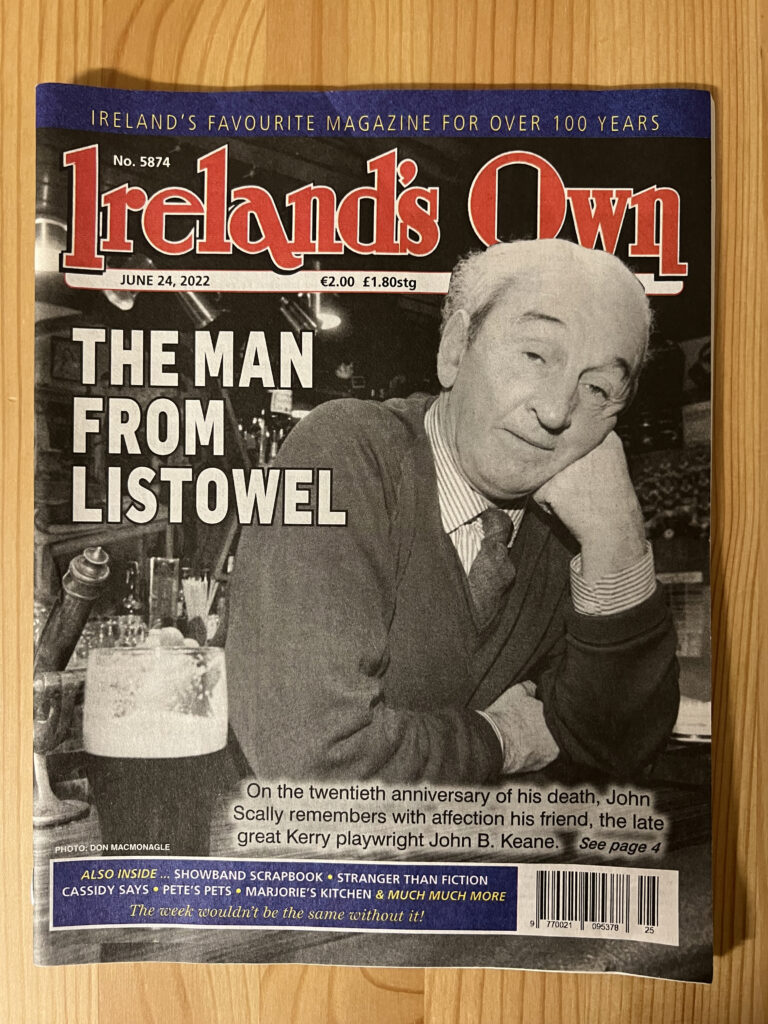
What did I write?
A significant focus of my research is on the working, living and health experiences of Belfast and Northern Ireland’s linen mill workers, especially the spinning mills. This comes from growing up in a small town in NI with a vast spinning mill open until 1997, where generations of my family worked. My article in Ireland’s Own is a shorter form of an article and podcast episode I created for Epidemic Belfast. It’s titled Linen Workers in Belfast: Lichen, Lungs and Loss of Limbs.
Here’s the article as featured in Ireland’s Own:
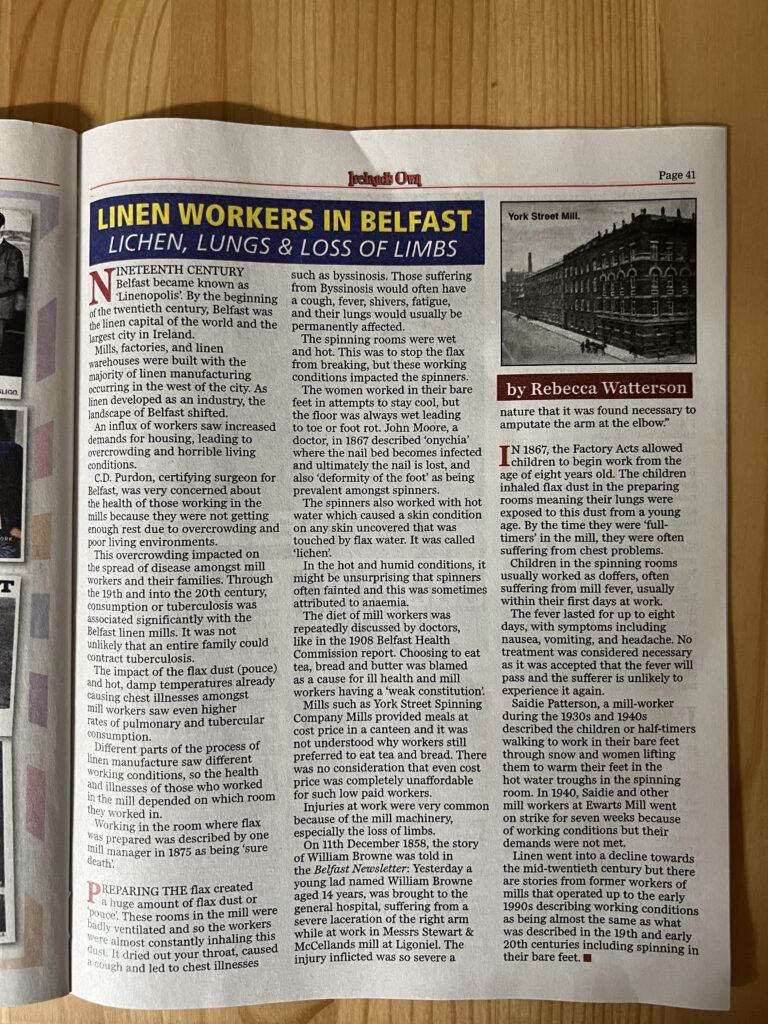
A written copy of my article in Ireland’s Own:
Nineteenth century Belfast became known as ‘Linenopolis’. By the beginning of the twentieth century, Belfast was the linen capital of the world and the largest city in Ireland. Mills, factories, and linen warehouses were built with the majority of linen manufacturing occurring in the west of the city. As linen developed as an industry, the landscape of Belfast shifted.
An influx of workers saw increased demands for housing, leading to overcrowding and horrible living conditions. C.D. Purdon, certifying surgeon for Belfast, was very concerned about the health of those working in the mills because they were not getting enough rest due to overcrowding and poor living environments.
This overcrowding impacted on the spread of disease amongst mill workers and their families. Through the 19th and into the 20th centuries, consumption or tuberculosis was associated significantly with the Belfast linen mills. It was not unlikely that an entire family could contract tuberculosis. The impact of the flax dust (pouce) and hot, damp temperatures already causing chest illnesses amongst mill workers were connected to high rates of pulmonary and tubercular consumption.
Different parts of the process of linen manufacture saw different working conditions, so the health and illnesses of those who worked in the mill depended on which room they worked in. Working in the preparing room where flax was prepared was described by one mill manager in 1875 as being ‘sure death’.
Preparing the flax created a huge amount of flax dust or ‘pouce’. These rooms in the mill were badly ventilated and so the workers were almost constantly inhaling this dust. It dried out your throat, caused a cough and led to chest illnesses such as byssinosis. Those suffering from byssinosis would often have a cough, fever, shivers, fatigue, and their lungs would usually be permanently affected.
The spinning rooms were wet and hot. This was to stop the flax from breaking, but these working conditions impacted the spinners. The women worked in their bare feet in attempts to stay cool, but the floor was always wet leading toe or foot rot. John Moore, a doctor, in 1867 described ‘onychia’ where the nail bed becomes infected and ultimately the nail is lost, and also ‘deformity of the foot’ as being prevalent amongst the people working in the spinning departments.
The spinners also worked with hot water which caused a skin condition on any skin uncovered that was touched by flax water. It was called ‘lichen’. In the hot and humid conditions, it might be unsurprising that spinners often fainted and this was sometimes attributed to anaemia.
The diet of mill workers was repeatedly discussed by doctors, like in the 1908 Belfast Health Commission report. Choosing to eat tea, bread and butter was blamed as a cause for ill health and mill workers having a ‘weak constitution’. Mills such as York Street Spinning Company Mills provided meals at cost price in a canteen and it was not understood why workers still preferred tea and bread. There was no consideration that even cost price was completely unaffordable for such low paid workers.
Injuries at work were very common because of the mill machinery, especially the loss of limbs. On 11th December 1858, the story of William Browne was told in the Belfast Newsletter:
Yesterday a young lad named William Browne aged 14 years, was brought to the general hospital, suffering from a severe laceration of the right arm while at work in Messrs Stewart & McCellands mill at Ligoniel. The injury inflicted was so severe a nature that it was found necessary to amputate the arm at the elbow.
In 1867, the Factory Acts allowed children to begin work from the age of eight years old. The children inhaled flax dust in the machine and preparing rooms meaning their lungs were exposed to this dust from a young age. By the time they were ‘full-timers’ in the mill, they were often already suffering from chest problems. Children in the spinning rooms usually worked as doffers, often suffering from mill fever, usually within their first days at work. The fever lasted for up to eight days, with symptoms including nausea, vomiting, headache, and fever. No treatment was considered necessary as it was accepted that the fever will pass and the sufferer is unlikely to experience it again.
Saidie Patterson, a mill worker during the 1930s and 1940s described the children or half-timers walking to work in their bare feet through snow and women lifting them to warm their feet in the hot water troughs in the spinning room. In 1940, Saidie and other mill workers at Ewarts went on strike for seven weeks because of working conditions but their demands were not met. Linen went into a decline from around the mid-twentieth century but there are stories from former workers of mills that operated up to the early 1990s describing working conditions as being almost the same as those described in the 19th and early 20th centuries including spinning in their bare feet.
© The Author(s) 2021. Any unauthorised broadcasting, public performance, copying or re-recording will
constitute an infringement of copyright.
This article is copyright. If you use, please cite appropriately. If you have any questions or queries, do get in touch.
I’m in the History Mags!
Getting published in Ireland’s Own was the most incredible feeling! I can’t wait to pitch some more ideas to different history magazines. Have you been published in any magazines? Do you have any tips for writers?
